

Competitor pricing is rarely visible in full. Competitor behavior usually is.
That distinction matters. A bidder's exact wrap rate, labor build, indirect treatment, and fee strategy may not be available at the start of a pursuit. But the company's posture is often hiding in plain sight: what it has recently won, what it has lost, where backlog is eroding, where it is hiring, where it is cutting, who is leaving, and what markets it is suddenly chasing.
Those signals do not replace detailed pricing intelligence. They make it better.
They help teams form an early view of whether a competitor is likely to bid aggressively, protect margin, take staffing risk, defend an incumbent position, or buy into a market. That early view can shape capture strategy long before final PTW modeling is complete. It also pairs naturally with the upstream pricing work we wrote about recently: the more you understand a competitor's likely posture, the more deliberately you can shape the procurement structure around it.
The discipline is to build a competitor signal sheet. It does not need to be elaborate. A useful first pass can be assembled in under an hour for any major competitor on a major pursuit. The goal is not to prove exactly how a competitor will bid. The goal is to read the pattern, assign a likely posture, and determine how that posture should influence your capture, pricing, and proposal strategy.
The eight signals below tend to produce the most actionable insight. They are categories, not a ranked list — but in our experience, backlog pressure and cost structure stress carry the most predictive weight, while hiring patterns and leadership turnover are more inferential and benefit from corroboration.
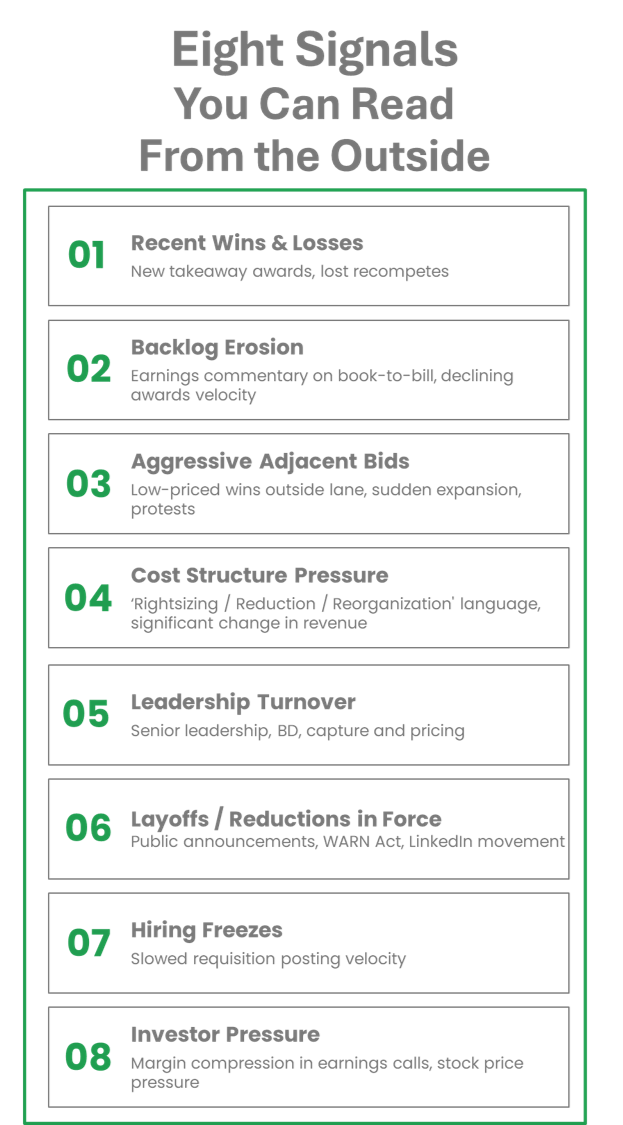
1. Recent Wins and Losses
A bid posture signal. Look at the past twelve to twenty-four months. Takeaway wins suggest a competitor growing through aggression — bidding tight, taking risk, displacing incumbents. Lost recompetes suggest backlog erosion or weakening incumbent position — pressure to replace revenue quickly.
Both produce aggressive bidding, but for different reasons. Do not treat all aggressive competitors the same. Some bid aggressively from strength. Others bid aggressively from pressure.
2. Backlog Erosion
A revenue replacement signal. Watch for declining book-to-bill, contraction in core lanes, and weakening customer sets in earnings commentary.
A competitor with shrinking backlog has more pressure to win the next pursuit than one with healthy backlog. That pressure translates into margin compression, more aggressive staffing assumptions, and greater willingness to take transition risk. Expect motivation to show up in the bid.
3. Adjacent-Market Behavior
A risk appetite signal. When a competitor starts winning low-priced work outside its traditional lanes, expanding into customer sets it hasn't historically pursued, or moving into markets where it has thin past performance, ask whether the move reflects strategic expansion or distress-driven pursuit behavior.
A company entering a new market from strength may invest heavily, price aggressively, and still execute well. A company chasing adjacent work because its core market is weakening may submit a compelling bid but struggle to deliver. If a competitor is stretching, ghost their credibility — past performance, workforce, customer intimacy, delivery infrastructure — or whether they're buying into the market through price.
4. Cost Structure Pressure
An economic stress signal. Watch for "rightsizing," "reduction," "reorganization," "efficiency," or "cost transformation" language in earnings calls and investor presentations. Also watch for unexplained changes in segment performance or operating margin.
A company resizing its cost base may bid more aggressively to preserve revenue absorption, and may push more risk into execution through leaner staffing or lower indirect burden. This doesn't mean the competitor is weak — in some cases, restructuring creates a more competitive company. But the economic behavior is changing. Look for disconnects between their public cost pressure and the solution they're likely to propose.
5. Leadership Turnover
When the people making pursuit, pricing, or investment decisions change, historical behavior becomes a less reliable guide.
Senior leadership turnover (CEO, CFO, COO, BU lead) signals strategic repositioning or financial pressure. BD or capture leadership turnover signals competitive disruption — the competitor may not have the same customer relationships or pursuit playbook. Pricing leadership turnover signals architectural risk — new fee posture, indirect treatment, or risk tolerance, and inconsistent behavior for six to twelve months.
Turnover doesn't automatically weaken a competitor. But predictability is itself a capture asset, and turnover degrades it.
6. Workforce Contraction
Layoffs, RIFs, and hiring freezes are different mechanisms of the same signal: the competitor's capacity to deliver is changing. Read with granularity.
Involuntary reductions in the operating group that would execute your pursuit are highly relevant — the competitor may lack the bench, management capacity, or delivery continuity to perform what it bids. Voluntary slowdowns — frozen requisitions, stalled hiring in key labor categories — signal whether the competitor is willing to build the workforce it will commit to. A compliant staffing plan isn't a credible one if the hiring engine has stalled.
This matters more under fixed price. Aggressive fixed-price bids aren't disqualifying simply because they're low. The real issue is whether the staffing, solution, and delivery model make the price credible. If a competitor appears staffing-constrained, frame your own bench strength, transition certainty, or recruiting capability as a discriminator. Compete on the credibility of execution, not just price.
7. Protest Behavior
A competitor protesting more frequently after contested losses is signaling deteriorating customer relationships, mounting pipeline pressure, or willingness to accept friction with the customer to recover revenue. Those conditions may indicate a more aggressive or less predictable posture on the next pursuit.
Protest frequency is publicly visible. GAO decisions are public. Sustain rates are calculable. A competitor with a recent uptick in protests may be under pressure. They may bid more aggressively, and they may be more willing to challenge an adverse award decision. Build that into your evaluation risk profile from the start.
8. Investor Pressure
Public, PE-owned, family-owned — each ownership structure produces different bid behavior.
For public companies, watch for margin compression, activist commentary, declining guidance, or emphasis on cash flow and EBITDA. The company is being asked to deliver financial outcomes that may not align with conservative bid behavior.
For PE-owned competitors, watch the hold-period clock. A company three years into a five-year hold has different bid incentives than one entering year six and seeking exit. Late-hold competitors optimize for sale-value metrics.
For family-owned or founder-controlled competitors, expect more idiosyncratic behavior — the economic logic is real but less programmatic.
Expect investor-pressured competitors to be selective where they invest, aggressive where they need revenue, and cautious where the opportunity threatens margin.
Not All Aggression Is the Same
One of the most important lessons from these signals is that aggression has different causes.
Some competitors bid aggressively from strength. They have a cost advantage, strong delivery infrastructure, healthy backlog, and a deliberate strategy to expand in a market. That kind of aggression can be sustainable.
Others bid aggressively from pressure. Backlog is eroding. Costs are under stress. Leadership has changed. Investors are demanding results. Hiring has slowed. The company needs a win. That kind of aggression may win awards, but it can create execution risk.
For capture teams, the distinction matters. You do not respond to a strong, structurally advantaged competitor the same way you respond to a pressured competitor trying to buy revenue. The first may require a sharper price-to-win strategy. The second may create room to emphasize execution credibility, staffing realism, transition confidence, or risk reduction.
The Bottom Line: The Pattern Is the Point
You do not need perfect pricing data to understand competitor behavior. You need disciplined signal reading.
No single signal is decisive. A competitor with one of these conditions is in a different position than a competitor with several, and a competitor with several is in a different position than a competitor with none. The eight categories are useful because they make pattern recognition possible.
A competitor with backlog erosion, recent capture leadership turnover, and aggressive adjacent bids in the last ninety days is a competitor under sustained pressure. That competitor is likely to bid your pursuit aggressively — possibly more aggressively than their cost structure supports. The evaluator's judgment may catch what the price alone does not. That changes how you position your bid against theirs.
A competitor with stable backlog, strong recent wins, no leadership turnover, and visible hiring in the relevant capability area is a competitor in a strong position. They will bid disciplined, defend margin, and rely on their incumbent advantages or domain depth. Your bid needs a different strategy against them.
Reading the signals is not predictive in the certain sense. It is predictive in the probabilistic sense — which is the right standard for competitive intelligence work. The pattern tells you what posture to expect. The posture tells you how to position. The positioning is where the next win comes from.
Too many contractors wait for pricing data that never arrives. The teams that win read the signals, infer the posture, and shape the bid accordingly. That's the discipline that separates teams competing on price from teams competing on judgment.
At BlackFlag Advisors, we help contractors turn public-market signals into actionable competitive intelligence. By connecting competitor behavior, cost structure, pricing strategy, and evaluator decision-making, we help teams anticipate how competitors are likely to bid — and position their own proposals to win.
Need help reading the competitive signals before your next pursuit? Let’s talk.