

The Fixed-Price Shift: What the April 30 Executive Order Means for GovCon
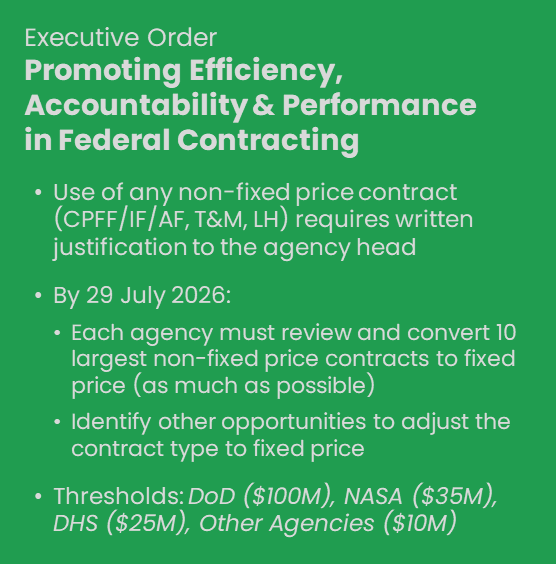
On April 30, 2026, the White House issued the Executive Order “Promoting Efficiency, Accountability, and Performance in Federal Contracting.” The order directs federal agencies to make fixed-price contracts, including contracts with performance-based considerations, the default and preferred method of procurement. It also requires agencies to justify the use of non-fixed-price contract types, including cost-reimbursement, time-and-materials, and labor-hour contracts.
The policy intent is clear: the Government wants more predictable costs, clearer deliverables, stronger contractor accountability, and better alignment between payment and performance. The order frames fixed-price contracting as a way to promote budget discipline and reduce the risk of cost growth borne by the Government.
But for contractors, the implications go well beyond compliance.
This is not simply a contracting-policy change. It is a competitive strategy change.
The EO Operationalizes the April 2025 Procurement Reform Direction
The April 30 Executive Order should not be viewed in isolation. It operationalizes the procurement reform direction that began taking shape in April 2025.
In April 2025, the Administration directed agencies (through executive orders and subsequent fact sheets) to prioritize commercial, cost-effective solutions in federal contracting. The policy direction was to move agencies away from unnecessary custom development and toward commercially available products and services where practicable. Agencies were directed to review pending procurements involving non-commercial goods or services and justify exceptions where commercial alternatives could not meet the requirement.
That earlier policy established the strategic direction: simplify procurement, use commercial solutions where possible, reduce unnecessary customization, and improve cost-effectiveness.
The April 30 Executive Order operationalizes that direction by turning broad procurement reform goals into near-term contracting actions: fixed-price defaults, justification requirements for non-fixed-price contracts, and agency reviews of large existing contracts.
By making fixed-price and performance-based contracts the default preference, the Government is creating a mechanism to translate those policy goals into acquisition behavior. Fixed price requires agencies to be more disciplined about defining outcomes, deliverables, assumptions, and performance expectations.
In short, April 2025 set the direction. April 30 operationalizes it.
Why Fixed Price Changes the Competitive Game
Fixed price changes how contractors compete because it changes the range of possible pricing outcomes.
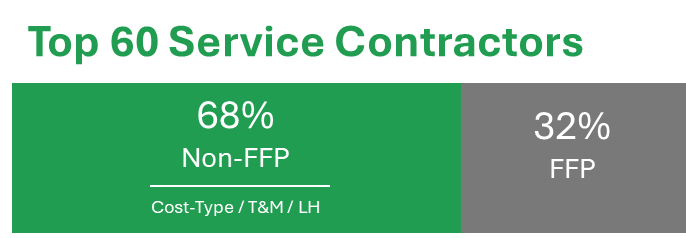
Under cost-type, T&M, or labor-hour structures, pricing outcomes are often more constrained. The Government may evaluate labor categories, hours, cost realism, staffing adequacy, and reimbursement logic in ways that limit how far bidders can diverge before creating evaluation risk.
Fixed price creates more room for variation.
One bidder may propose incumbent continuity. Another may green the workforce. Another may use automation, shared services, reach-back, lower-cost delivery centers, or a different prime/sub structure. One company may price aggressively and accept more execution risk. Another may price a premium around transition confidence, mission continuity, or reduced performance risk.
That wider range of possible pricing outcomes is central to the shift.
Fixed price transfers more cost and performance risk to the contractor. But it also gives contractors more room to design the economics of the work. This risk transfer can create both opportunity and danger: contractors may benefit if they can control costs, but they may also absorb overruns if the work is poorly defined, underpriced, or difficult to manage.
For competitors, the question becomes less about who has the lowest rates and more about who can structure the work most effectively.
Outcome-Based Contracting Raises the Stakes
The Executive Order does not simply favor fixed-price contracting. It emphasizes fixed price tied to performance-based metrics and defined deliverables. That distinction is important.
Outcome-based contracting requires the Government to define what success looks like. It also requires industry to understand how those outcomes translate into staffing, delivery model, risk, cost, and margin.
Poorly defined outcomes can create risk for both sides. Contractors may price in contingency, inflate risk premiums, or underprice work they do not fully understand. Agencies may unintentionally create evaluation models that reward aggressive pricing without adequately testing execution credibility.
Well-defined outcomes create a different environment. They allow sophisticated bidders to design delivery models around measurable performance, efficiency, automation, labor mix, and execution control.
That is where the competitive opportunity sits.
The companies that can connect technical solutioning, cost architecture, staffing, transition, and performance management will be better positioned than companies that treat fixed price as a simple conversion from cost-type pricing.
The Bottom Line
The April 30 Executive Order operationalizes the Administration’s broader procurement reform agenda by moving fixed-price, performance-based contracting from policy preference to near-term acquisition action.
For contractors, that creates both risk and opportunity.
Fixed price can punish poor estimating, weak delivery controls, and unclear performance assumptions. But it can also reward companies that understand their cost architecture, structure the work intelligently, and shape the pricing factors before the RFP arrives.
Sophisticated bidders will understand the rules. Less sophisticated bidders will treat fixed price as just a riskier version of cost-type — and they leave money on the table.
At BlackFlag Advisors, we help contractors understand how policy shifts translate into competitive pricing and PTW strategy. As the Government moves toward fixed-price, outcome-based contracting, we help teams assess where they are advantaged, where they are exposed, and how competitors are likely to price risk, structure delivery, and protect margin.
Need help evaluating how the fixed-price shift could impact your pipeline, recompetes, or PTW strategy? Let’s talk.