

In December, the Government Accountability Office (GAO) released its Bid Protest Annual Report for GFY2025. While the headline shows a 6 percent drop in filings, the data reveals a more complex shift in how protests are being resolved. Below, we break down the key statistics, the rising role of the Court of Federal Claims, and why the "effectiveness rate" remains the most important metric for contractors to watch.
Fewer Protests — with an Asterisk*
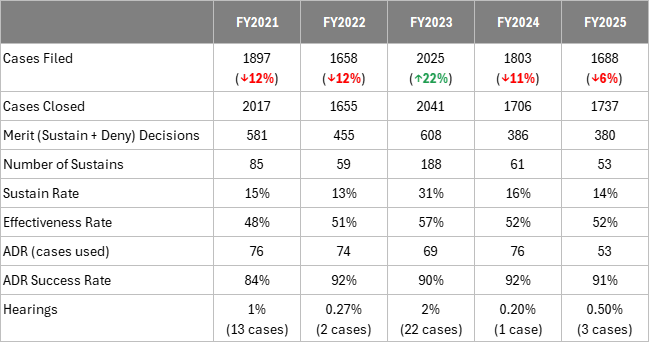
In GFY2025, protesters filed 1,688 cases at GAO, down roughly 6 percent from GFY2024. Zooming out further, protest filings have declined in six of the past seven fiscal years, with only limited year-to-year volatility.
Make no mistake — protests are down — but there are important caveats.
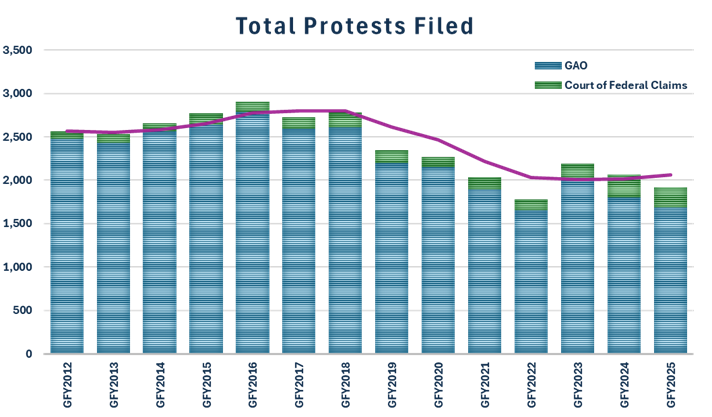
Historically, we see year-over-year fluctuations in protests, some of this volatility can be attributed to timing. More importantly, a growing share of sophisticated protesters are bypassing GAO entirely and filing directly at the U.S. Court of Federal Claims (COFC) when jurisdiction allows. While COFC filings remain smaller in absolute terms, they have grown dramatically — more than doubling over the past several years.
Looking at a rolling average of combined GAO and COFC protest filings (see below) helps clarify the trend. Over the past 14 years, protest activity peaked over GFY2016-GFY2018, then sharply declined between GFY2019-GFY2022. The decline — approximately 28 percent — has since flattened, with total protest activity remaining relatively flat over the past four fiscal years.
Several structural factors contributed to this shift, but two stand out:
Task Order (TO) Protest Thresholds were raised from $10M to $25M in May 2018, with GFY2019 being the first full year of impact.
DoD’s “Enhanced Debriefing Procedures” went into effect as a class deviation in March 2018 (i.e. agency had discretion to implement) and fully implemented in March 2022, providing offerors with more post-award insight.
Layered on top of these long-term trends, GFY2025 protest volume is likely suppressed due to award delays and an increased reliance on sole-source bridge actions from procurement reform efforts.
It will be worth watching whether the FY 2026 National Defense Authorization Act (NDAA) meaningfully alters protest behavior—although any impact is likely to be limited. The NDAA introduces a new layer of financial exposure for incumbent DoD protesters by authorizing the withholding—and potential forfeiture—of up to 5 percent of payments on performance extensions if a GAO protest is dismissed as meritless. For incumbents, the decision to protest now carries a direct cash-flow and P&L risk, not just a legal one.
The Effectiveness Rate Still Tells the Real Story
The most important metric in the GAO report is not the sustain rate. It is the effectiveness rate.
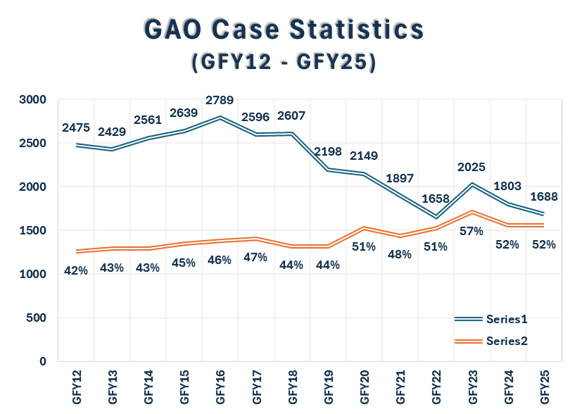
With the exception of GFY2023 — when the CIO-SP4 protests skewed the data due to widespread corrective action — this number has remained relatively consistent in recent years. By comparison, effectiveness rates historically hovered in the mid-40 percent range prior to GFY2020.
The change beginning in GFY2020 is notable. That year saw a one-time spike in the use of Alternative Dispute Resolution (ADR), likely driven by COVID-19 constraints. What followed, however, appears to be more structural: agencies increasingly opting for early corrective action, combined with a reduction in low-probability protests due to higher task-order thresholds and enhanced debriefings.
One of the most revealing statistics in the GFY2025 report reinforces this point. GAO issued only 380 decisions on the merits — the lowest number in recent years. The majority of cases were dismissed, withdrawn, or resolved through agency corrective action before GAO reached a decision.
From a capture and pricing perspective, the implication is clear: protests continue to work, particularly when they are well-crafted, targeted, and strategically timed.
Sustain Rates: Low, Stable, and Often Misunderstood
GAO sustained 53 protests in GFY2025, resulting in a sustain rate of approximately 14 percent. This figure is consistent with recent non-anomalous years and should not be interpreted as evidence that protests are rarely successful.
The sustain rate only measures the subset of cases that reach a merits decision. It excludes the growing share of protests resolved through voluntary corrective action — which is often precisely where protesters achieve their practical objectives.
In practice, the effectiveness rate remains the more meaningful proxy for protest value.
Why Protests Are Sustained: A Familiar—but Important—Pattern
GAO identified three primary grounds for sustaining protests in GFY2025:
Unreasonable technical evaluations
Unreasonable cost or price evaluations
Unreasonable rejection of proposals
These categories are familiar—and for good reason. They continue to align closely with the areas where evaluation records most often break down under scrutiny.
It is important to understand what GAO means when it labels an evaluation “unreasonable.” GAO does not substitute its judgment for that of the evaluators, nor does it second-guess qualitative scoring simply because a protester disagrees with the outcome. Instead, GAO assesses whether the agency’s evaluation was reasonably documented, internally consistent, and aligned with the solicitation’s Section L and M criteria and applicable procurement statutes and regulations.
Disagreement alone is insufficient. But when the evaluation record cannot support the agency’s conclusions — or when the agency departs from the stated evaluation framework — GAO remains willing to intervene.
Final Thought
The GFY 2025 report reinforces a vital truth for capture and pricing teams: protests continue to work. The high effectiveness rate (52%) proves that agencies are often willing to take a second look if a protester can point to specific, documented inconsistencies in the evaluation record.
At BlackFlag Advisors, we focus on the intersection of competitor behavior and evaluator decision-making. By modeling competitor cost structures, pricing strategies, and cost realism risk, we help teams forecast awardable price points and position bids to win—not just compete.
Need help understanding your competitive position and fortifying your PTW strategy before the next proposal? Let’s talk.